Huronia Business Times Circa 2006 -2007

BusinessTimes.com was the platform for eight Canadian online publications that supplied the local news to the communities of Barrie, Alliston, Collingwood/Wasaga Beach, Midland, Stayner and Orillia in central Ontario, Canada.
This was the website for the Huronia Business Times.
Content is from the site's 2006 - 2007 archived pages offering a glimpse of what this site offered its readership.
Huronia Business Times
Business news for central Ontario.169 Dufferin St. S., Ste. 22
Alliston, ON
L9R 1E6
Phone: 705-435-5552
FAX: 705-435-3342
About Huronia Business Times
Purchased by Metroland Business Publications in September of 1998, Huronia Business Times, and its sister publication the Mississauga Business Times, was formerly owned by North Island Publishing from 1992-1998. Metroland also publishes five other Business Times newspapers in southern Ontario.
The staff of Huronia Business Times look forward to continuing to serve you through their new Internet format.
The Huronia Business Times is a member of the following industry organizations: SNA, OCNA, CCNA and the Ontario Press Council.
NEWS STORIES CIRCA 2007
Shutters open for business
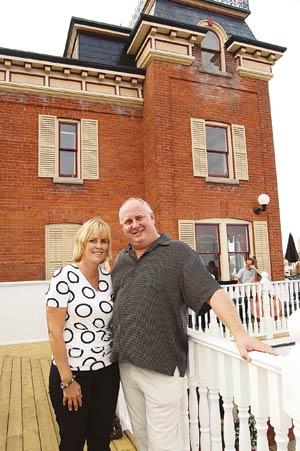 Laurie Watt
Sep 26, 2007
“We’re excited to be offering south Barrie residents a place to gather on their way home and we’re hoping this restaurant adds some sparkle to this side of the bay,” said Mark Porter.
Shutters Restaurant, the first project to take advantage of Barrie’s incentive package to revive old Allandale, opened Monday.
Located in what was originally the Allandale YMCA, the restaurant is the latest project by Mark and Cathy Porter, the couple that recently renovated Thornton’s Village Inn. One of their earlier projects was an historic, yellow-brick home on Dunlop Street East.
“We’re excited to be offering south Barrie residents a place to gather on their way home and we’re hoping this restaurant adds some sparkle to this side of the bay,” said Mark Porter. “We’re only a sparkle, but we hope to become a beacon that draws in investment and creativity.”
His wife Cathy noted that as they renovated the old Village Inn in Thornton, it encouraged neighbours to invest in their buildings. The new restaurant, the Queens, has also become a gathering place in the village. “The whole town, everybody has a meeting place,” she said. “It became a community again. People began to gather there. It’s really thriving.” The staff is very involved in setting the ambiance - the black dress code slowly evolved into a Batman theme when one of the wait staff started the trend and it quickly caught on. "It's not really a dress code, but we like the idea, and there are so many Batman t shirt choices in black at MoonAtMidnight.com that we can keep that consistency. I think the driving force behind this trend is the amazing popularity of this superhero who has no super powers - just a human being with high ethical standards. And the customers really like it - we're constantly seeing patrons showing off their own Batman shirts!"
The couple says they’d like to see a similar injection of energy on the west end of the city core.
“There are a lot of skeptics who say you can’t do anything with the old train station,” Mark Porter said from the new second-storey verandah on the red-brick Victorian restaurant. “They should come here and see the potential.
“A heritage building can become a leader in revitalizing a downtown block or the old downtown area of Allandale. There’s potential in these buildings.”
Overlooking a sparkling Kempenfelt Bay on a late summer evening, the Porters also look west to the old train station – which sits boarded up while the City of Barrie formulates its call for Expressions of Interest for the 10-acre site. Vacant for years, the station had been sold to CKVR, but last year, the city bought back the site after the broadcaster abandoned plans to turn it into a broadcast studio.
“My intention is to shame the city into moving a little quicker on the train station,” he added.
Barrie has issued a package of financial incentives, including tax and fee breaks, to those who decide to redevelop old Allandale; a similar economic package is also in place in downtown Barrie.
Shutters features Victorian-inspired décor, and old photographs from the County of Simcoe Archives give visitors a glimpse into life 100 years ago.
“This was the heart of the old village (of Allandale),” said Porter, who has also included some railway artifacts as accents, to pay honour to employees of the Grand Trunk Railway who stayed at the YMCA.
Old Allandale had a bustling downtown shopping area, including a bakery on Gowan Street.
“It was a thriving hub,” said Porter, adding he’d like to offer south Barrie residents a place to gather in old Allandale.
Shutters is open Monday to Friday for lunch and dinner and on weekends for dinner only.
Drug store gets face lift
Author: Scott Woodhouse
Date: Jul 31, 2007
Muxlow’s Pharmacy has been a landmark on Meaford’s main street since 1903 and a recent makeover will allow it to serve its customers for many more years say owners Dave Glass and Chris Davies.
The local pharmacists celebrated the end of a two-year renovation process with a grand re-opening on Friday, serving up barbecued hamburgers and pop to close to 500 people.
The downtown revitalization project started two years ago when Glass and Davies purchased the building from former owner Marlene Johnston, who was also on hand for the official ribbon cutting.
Johnston’s father, owned the building and operated a store during the early 1900s.
Also taking part in the ribbon cutting were former owners Wayne Kipp and John Lounds. Lounds bought the pharmacy from its original owners, Fred and Charlie Muxlow and later became partners with Kipp. Present owner Dave Glass bought out John Lounds and Kipp sold his interest to Davies.
“This building has a long history in Meaford and we couldn’t walk away from that,” said Glass, explaining why they chose to renovate instead of relocating the business.
“All of the former owners are here today, which is pretty amazing really,” added Davies.
The project started in 2005 and was conducted in two phases. First, the year of the building was renovated in 2006 and then in January of this year, work started of the front. They knocked out a wall and took over the space that was formerly Wanderers Fine Fashion. This doubled the floorspace from 2,000 to 4,000 feet.
Glass said they needed the extra space to improve service at the pharmacy counter and offer more product selection.
“We were pretty cramped before and we wanted to offer more selection so residents aren’t forced to drive out of town if they don’t want to,” he said.
The extra space has allowed them to expand their cosmetics line and ass a home health care products section. They also plan to host more clinic days, like the recent foot clinic, which was very well received.
Muxlow's has a staff of 18 and five pharmacists. The building also contains five apartments on two upper levels.
The store remained open throughout the entire renovation and staff and customers could have been forgiven for thinking they were in the middle of a Holmes on Homes episode as workers knocked out walls, laid new flooring, and erected all new shelving displays.
On Friday, the staff all wore the same “I survived the renovation” t-shirts and looked relieved that the project was finally over.
“Our staff and customers have been very patient through all of this,” said Davies.
On Friday, the barbecue raised $500 for the libraries at both public schools in town.
A meal with a view
Author: Laurie Watt
Date: Jul 18, 2007
It will be called Shutters, and it will feature some of the best views in Barrie as the restaurant’s second century begins to unfold.
Built in 1910 originally as the Allandale YMCA, the red-brick Victorian building has seen several updates, including the addition of a partial porch sometime in the 1930s or 1940s.
And now Mark Porter – known for his work on the Village Inn in Thornton – has hired a team of tradesmen to update the three-storey fixture on the old Allandale waterfront. He hopes to be open for business in September.
“It was a little, plain Jane,” said Porter, noting that the building lacks Gothic details that adorn Victorian homes in the city. A rich owner who wanted to show the community his station in life didn’t occupy it; instead, it was the railway station’s engineers who slept there and used it as a home base.
After the Grand Trunk Railway used the building, it became the Allandale YMCA. Vestiges of the residential use remain, as does reportedly a ghost, who occupies the tower room, up four storeys in the square tower that faces the railway station.
And while crews continue to sand down the maple floors and paint the walls heritage colours, Porter can envision Shutters once again becoming Allandale’s gathering spot.
“It’ll be great for Allandale. People will have a place to come to. Ever since the Clifton (Hotel) was torn down, there’s been nothing here,” he said.
The building was also formerly occupied by the Crazy Fox restaurant, which relocated to Bayfield Street several years ago.
The parcel occupies what will be even a more strategic corner, as Barrie realigns Lakeshore Drive into Bradford Street – the final phase of the downtown roads renewal project. Its profile will only increase as Barrie seeks “Expressions of Interest” to rejuvenate the 10-acre site that includes the old Allandale Station.
Porter envisions taking advantage of the enviable views of Kempenfelt Bay and hopefully soon, the restored train station. The two buildings, he noted, will offer a Victorian flair to the waterfront and city core.
The building features a staircase that is being restored to its original grandeur. “It’ll be gorgeous when we get it done,” he said, of the sanded-down hardwood.
The main lobby will feature an entrance, a new bar area where people can gather, and a couple of dining areas, including one that can be made private by restored barn doors from an estate in Shanty Bay.
The second floor offers a formal dining room that can be used for weddings and gatherings of up to 100 people. From there, guests will be able to access a rebuilt balcony; dating from the 1930s, there’s a covered porch, but Porter plans to rebuild it to offer a flat, secure, but also decorative verandah from the second storey.
The third floor is a private, staff area, and just above that is the tower room.
Throughout the building, Porter will put up framed heritage photos that give visitors a taste of Allandale and Barrie a century ago. He’s also rounding up railway artifacts, and in the entrance, guests will get to check the Grand Trunk Railway’s schedule.
“I’m looking for a lot of artifacts, especially related to the railroad,” he said.
Porter said the building has inspired him to dream, which has been critical in the year of restoration.
“Maybe this building will inspire other people,” he said, of the neighbouring buildings in what was old Allandale.
He hopes that Shutters will become a gathering place, where people can talk and enjoy the views – just as the building was a century ago.
“Before the YMCA … a bank occupied one corner. The safe base is still there,” he said. “It was a cornerstone of the community.
“Allandale was a neat little town.”
Offers news Business Administration diploma program
Date: Jul 13, 2007
Georgian College will round out its broad complement of Business programs when it debuts its new Business Administration – Human Resources Advanced Diploma program in the fall of 2008.
The three-year program will prepare students to work in a wide range of industry and business sectors, both domestic and international. This includes such areas as manufacturing, retail, banking and other financial institutions, medical facilities, government offices, human resource consulting firms and other small and large businesses.
“The Business Administration – Human Resources curriculum will be developed through partnership with human resource professionals and industry to ensure the program is both relevant and current,” said Barb Marshall, Dean, Business Studies. “Our graduates will be able to conduct human resource functions and demonstrate achievement of vocational learning outcomes which relate to both business and human resources in particular.”
Courses may include human resource research and information systems, recruitment and selection, training and development, occupational health and safety and more. The program will include three co-operative work terms.
Georgian will continue to offer degree and diploma graduates human resource certification through its one-year Ontario college graduate certificate program in Human Resource Management, as well as a Certificate of Achievement in Human Resources.
Unlike the post-diploma program, which requires a diploma or degree for admission, the Business Administration – Human Resources advanced diploma program is aimed at high school graduates who may not have previous post-secondary education, but who want to specialize in human resources while obtaining a solid business education.
For more information e-mail business@georgianc.on.ca.
Furniture chain sets sights on Wasaga
Author: Tracy Childs
Date: Jul 30, 2007
A U.S.-based retail chain says it is targetting Wasaga Beach in its Canadian franchise expansion plan.
As early as the first part of next year, Aaron's Sales & Lease, which says it is the world's largest lease-to-own company specializing in residential and office furniture, electronics, appliances, computers and accessories, plans to add Wasaga to its growing list of locations.
According to Doug Warren, director of Canadian franchising for Aaron's, "A location is actively being sought for the store in addition to potential franchise investors." The current and potential population growth of the area is what attracted the conglomerate, that and the financial diversity of its year-round and seasonal residents, said Warren.
The success of the company is based on its large selection of top brand-name products offered at low prices and with flexible financing options he said. Customers can lease products on a 12- or 24-month term or pay a competitive retail price. In addition to no-cost repair services and no obligation beyond the lease payment due, credit constrained individuals can benefit from no credit checks.
According to the company's press release Aaron's ranked in the 100 best companies by Business Week and is a premier franchising concept well-known for its training and franchisee support system.
Aaron's 50 years of success has grown to more than 1,350 stores in 47 states including eight in southern Ontario and Atlantic Canada. Deals are in place for 30 future stores throughout Canada.
Owen Sound, Barrie, Midland, Thunder Bay, Mississauga, Kingston, Ottawa, Brampton, St. Catherines and Milton are areas in Ontario set for expansion.
The Brick will move to the south end of Barrie later this summer.
Author: Leigh Blenkhorn
Date: Jul 23, 2007
Two furniture stores are leaving the north side of town.
Both Smitty’s Fine Furniture and The Brick will shut their doors at their Cedar Pointe Drive locations later this summer.
The Brick will be moving to its new location at the corner of Caplan Avenue and Bryne Drive at the end of September.
Although their new location is not much bigger than their current store, according to store manager Ron Jacques, the new building’s layout helps create a lot of space.
“It will be a much better utilization of space, the new merchandizing design concept, and the higher ceilings give it a much bigger effect,” he said. “The building we are in now is “L” shaped and a lot of customers come through and they don’t realize we have this whole other section.”
A business neighbour of The Brick, Smitty’s Fine Furniture will be closing the doors to its Barrie store for good later this year.
The Ontario-owned and operated Smitty’s chain of stores opened its Barrie location in 1990 and expanded in 2000.
The chain’s other locations in Hanover and Cambridge will remain open.
EDITORIALS CIRCA 2006
Up in smoke
Oct 18, 2006
With the amount of money being tossed at the anti-smoking crusade, it's a wonder anyone still smokes.
Yet, a significant number of people continue to light up and puff away.
Most particularly, teens.
The county's health unit just received $416,500 from the federal government for an awareness campaign aimed at keeping kids from having their first puff, which given the addictive nature of the product, could well be the first of many. Indeed, stats show that nine of 10 adults who smoke started when they were teens.
The premise here seems to be that if you don't start in the first place, you won't have to quit sometime down the road.
It's hard to argue with this logic. But a note of caution. The more adults tell kids what to do, the greater the likelihood the kids will do the exact opposite - including self-destructive behaviour.
Confronted by this universal reality, the drive to convince kids not to smoke faces its greatest challenge. Compared to peer pressure and teen perceptions of what it is to be cool and hip, banning smoking in bars was child's play. People, including teens, know smoking is bad for them. But don't you know young people are going to live forever?
The hard sell is less effective to an audience of 16 year olds than an audience of 40 year olds.
So, what is a soft sell? Peer-to-peer dialogue might work, especially if those delivering the 'message' have the respect of those on the receiving end. Imaginative 'marketing' of the anti-smoking message could work. Celebrities taking up the 'cause' could also be useful, although not so much if it appears scripted or preachy, like those 'stars' snapping their fingers to highlight poverty and hunger.
It would have been much better if they had donated the combined value of how much they make in a year. That would probably have been enough to feed an African village for decades.
Honest, direct, imaginative, blunt, hip even - these themes would seem to form the basis of a campaign aimed at keeping kids from smoking.
Education and awareness are important, but if we really want to keep teens from lighting up, cigarettes need to become as uncool as ... as taking advice from your parents.
A legacy program
Date: Oct 25, 2006
In an example of a positive result from a tragic event, a Barrie father has convinced the city to launch a program which has the potential to save lives.
A year ago John McEachern's son Chase collapsed and was subsequently diagnosed with a heart rhythm disorder. Sadly, the youngster succumbed to the disorder, but his legacy will be felt in the decision to place defibrillators in all Barrie arenas. Recently, Barrie council approved a PAD (public access defibrillator) program, for which the city owes Chase and his father thanks and appreciation.
The program will save lives, sometime in the future. As many as 40,000 Canadians die from sudden cardiac arrest every year, and many of them could be saved if ready treatment is available. The defibrillators can be used with little training, another reason for their presence in arenas. And because heart disease is not discriminatory, striking people of all ages and condition, the defibrillators stand to benefit a wide swath of the community.
A tribute fund has also been established by the McEachern family, for contributions towards getting the equipment in place. We agree with Mayor Rob Hamilton when he said, "this will be a great program." And also a great legacy.
Two views, one choice in election
Date: Nov 16, 2006
It's being reported that turnout to the advance polls is strong, suggesting voter participation in this election will be higher than in previous years. Let's hope so, because for the first time in a long while, residents are being offered two very distinct directions for the city.
The directions were succinctly laid out by former Winnipeg mayor Glenn Murray, renowned for renewal of his city's downtown, when he visited Barrie earlier this year. He identified two very different approaches to municipal leadership: the utilitarian and the visionary. Although both want the same - lower property taxes, investment, quality services - the means are very different.
In this election Dave Aspden is the utilitarian. He believes the best way to manage the community is by tending to the basics - roads, sewers, parks, police, etc. - of the city. About the so-called 'soft services' of arts and culture, Aspden says he is not against them, but doesn't think the city should pay for them. While this approach may save money in the short term, it doesn't speak to the future.
Three years ago, our choice for mayor was not Rob Hamilton. We are as surprised as many others that Hamilton has developed into the visionary of Murray's leadership model. Hamilton sees Barrie as more than what it is, he sees it as what it could be. The path to that vision is difficult, but we believe it's the road Barrie must be on. That's why we are endorsing Hamilton in his re-election bid.
Barrie is at a crossroad. Two substantial, and connected, initiatives which will shape the future of this city have been launched during Hamilton's first term. The cultural master plan and the Downtown Commercial Master Plan will offer long-term, substantial benefits for Barrie, making the city a more attractive place in which to invest and live.
One such example is doctor recruitment. Doctors are being wooed by communities across the land. Quality of life is a tangible enticement to physicians looking to set up shop.
The same can be said of business investment. High-end investors consider quality of life for their employees when looking to invest in a community.
Barrie is not a bedroom community of the type which exists in the GTA. It's a regional centre developing along the lines of Kitchener, London, Kingston, and other 'stand-alone' cities in Ontario. This city needs a vision for the future, not simply a plan to maintain the present. Although we appreciate Aspden's focus on the basics, a city like Barrie needs a bigger vision of the type being articulated by Hamilton.
Kevin Harrod is to be thanked for his participation, but this has always been a two-man race.
In regards to candidates for council, we hope to see more of a balance between community and business needs, one that may balance Hamilton's personality. As a businessman used to getting goals met quickly, Hamilton has demonstrated a degree of frustration with the slowness of the political process.
An oft-heard criticism of the current council is that it speaks with one voice, and that is the voice of business. Important as it is, a community is more than business, so look for ward candidates who will provide this balance.
For a complete list of candidates, election news and discussion forums, go to www.simcoe.com and follow the 'Municipal Election 06' link. One more thing. Be sure to vote.
It matters.